
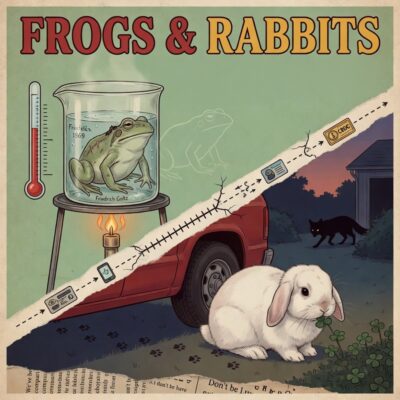
I read The Epoch Times every week. Have for a while now. Cover to cover, most weeks. It’s one of the few papers left doing actual journalism… you know, the kind where reporters go find out what happened instead of waiting for a press release to arrive. The kind where you walk away feeling as though you’ve learned something tangible and real worth sharing. If you’re not subscribed yet, fix that.
I mention it because an article I read last week absolutely blew my mind and actually made me quite irritated.
You know the frog story? Drop a frog in boiling water and it jumps out. Put it in cool water and slowly turn up the heat, and it just… sits there. Cooks. We’ve all heard it used as a warning about creeping normalcy, about how people miss the slow slide into catastrophe because no single degree uptick feels like the danger it actually is.
Turns out the story is a lie.
It traces back to a German physiologist named Friedrich Goltz, who in 1869 was running experiments to figure out whether the soul resided in the brain or the spinal cord. His method: remove portions of the frog’s brain and observe what the animal could no longer do. What he found was that a frog without its brain would sit calmly in slowly heating water and never try to escape. A frog with its brain intact felt the temperature rising and got out.
The experiment everyone has been citing for 150 years to explain human passivity was conducted on animals that had been surgically lobotomized first.
We’ve been literally comparing ourselves to a brain-damaged frog and calling it wisdom.
Let that sit now while I tell you about a Holland Lop rabbit named Luna. White, fluffy, the whole thing. My daughter was convinced she would literally die without one. Parents, you know how this goes. My wife had owned one as a kid so we caved. Within a few weeks we discovered our daughter was allergic, and Luna got relocated to the carport. She lived there for a couple of years, fed and cared for (mostly by my wife), comfortable. Then we decided to let her roam free in the backyard.
Luna loved it. She found a home under the shed. She found another home in a thicket of bushes. For almost a whole month she ate what she wanted and hopped around looking like something out of an Alice in Wonderland fever dream. My wife fell in love with watching her and I’ll admit, it was pretty adorable to have a bunny hop up to you while walking around on calls in the yard and watch eating the clover that we call grass.
Our two dogs had been trained to leave her alone since she arrived. They’d actually play with her and as a result, Luna never panicked when they came near because she had no reason to. They were her people. They had always been her people.
She’d never met a fox, though.
We’d seen one moving through the property at night. I remember the last time I saw Luna. She was sitting next to my truck near the road. Something made me stop and look harder because I just had a feeling this was going to be the last image I had of her burned in my brain.
The next day, she was no where to be found. We’ve walked every acre since. No trace. No sign of a struggle. Just… gone.
She probably never even understood what was coming at her. In her world, things with four legs that approached were either harmless or friendly. Nothing in her experience had taught her otherwise.
She was domesticated all the way through. And domestication, outside the fence, will get you eaten in the wild.
Here’s what ties both of these together, if it isn’t already obvious.
The frog story was never about frogs that couldn’t sense danger. It was about frogs that had been deliberately stripped of the capacity to sense it. Lobotomized first. Dropped in the pot second. And for 150 years, we looked at that and said, “yep, that’s us. That’s human nature.”
Maybe it is… but not because we’re frogs. Because we’ve let ourselves be operated on.
Think about what the last few decades have actually been: the slow, deliberate removal of discomfort. TV shows, news feeds and movies shocking our senses with horrific events to desensitize us to the actual horror happening all around us. Algorithmic feeds that only show you what you already believe. AI that answers before you’ve finished thinking. Convenience layered on convenience until the friction that used to build discernment, pattern recognition, the ability to notice something is off… until all of it just atrophies.
The researchers documenting cognitive dependency aren’t describing a natural trajectory. They’re describing generations forming cognitive habits inside an environment that has been optimized to remove struggle as efficiently as possible.
Luna didn’t know what a predator looked like because nothing in her life had ever been a predator. The fox didn’t have to be clever. It just had to show up.
Most people walking around today have never been genuinely threatened by the system they live inside. Someone always knows exactly where they are. Their company or the government has always sent a check, or processed a permit, or kept the lights on. The phone has always had signal. The internet has always been on. The bank has always been open.
The slightest shift in any of these things causes most people to enter panic mode almost instantaneously.
Now, Digital ID is just convenience to save the kids. CBDC is just simpler and easier for money transfers.
The slow accumulation of dependency doesn’t feel like a trap when the trap has been comfortable for so long. In fact, it feels like progress.
I believe those who are still sitting in the pot because they can’t feel the heat are doing so because somewhere along the way, the part of them that was supposed to sound the alarm got quietly removed. Not all at once. Just degree by degree. App by app. Dependency by dependency. Convenience by convenience. Policy by policy.
Until one day something shows up at the edge of the yard that has never shown up before, and they have no category for it, and no instinct to run.
Clearly, I’ve thought a lot about Luna this week. She wasn’t stupid. She just had no frame of reference for what was hunting her. She was too domesticated to be dangerous to anything, and too trusting to be safe from everything.
Don’t be Luna.
The fox is real. For most people, it’s already living inside your devices and your homes eating you slowly, and it is not interested in whether you believe in it or not.
Your co-workers and your loved ones may see one of the cages being built to guard their guns, stifle their freedom of speech, or force them to take vaccines that they know are poison… but they don’t see the numerous other cages that they have willingly constructed around their daily routines.
The capacity for discernment is a gift. It’s also a muscle. And muscles that never meet resistance don’t stay ready… they just quietly disappear. That’s not a metaphor anymore but a clinical finding. It’s also a policy outcome and the intended result of a system that benefits enormously from your comfort and your compliance and your willingness to hand over one more small piece of yourself in exchange for a little more convenience.
So here’s the question I’d like for you to sit with today: not whether any of this is true, but whether you’ve still got enough brain left to notice?
Most of you reading this have already jumped out of the pot or are in the process of crawling out. We thank the good Lord every day for each and every one of you. Know you are not alone. You are not paranoid. You are not behind. You are just paying attention in a world that has spent A LOT of money convincing you there’s nothing to pay attention to.
MARK37 exists for people who still have the instinct. Who feel what’s coming and want tools that actually match the moment. We are not selling fear. We are selling the fence. And a good fence, built right, and discernment of who and what you need to be protecting yourself from, is what will keep the fox out of your yard to begin with.